

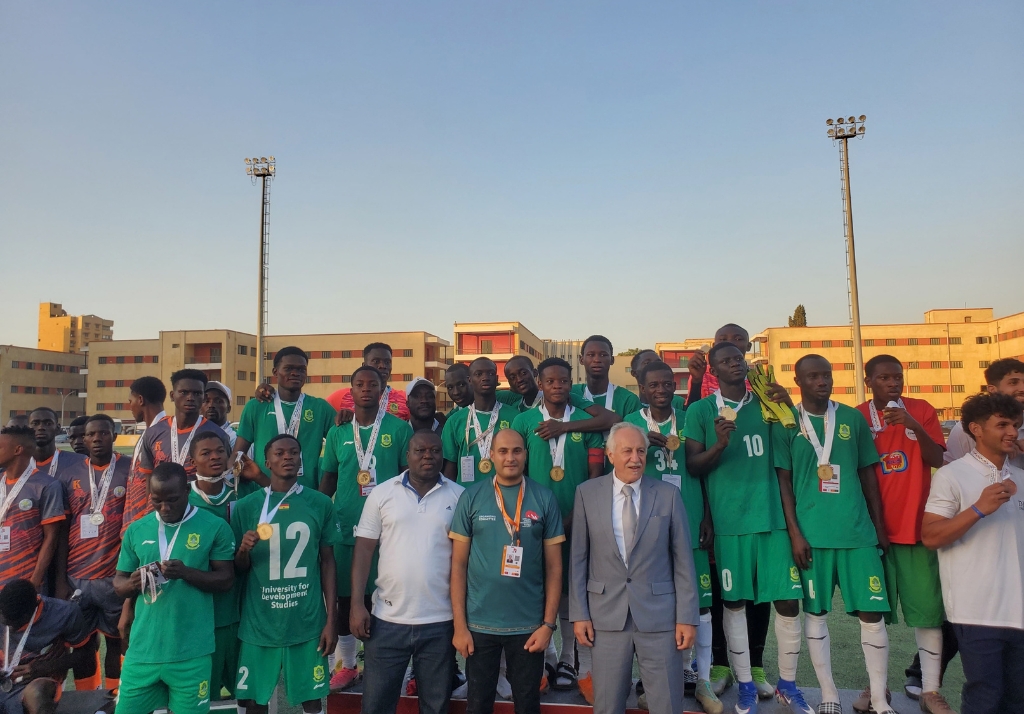
12th Fasu Games: University For Development Studies Ghana Are Men's Football Champions Again!!!
Winning once can be explained as a fluke, but winning twice requires something more. For the University for Development Studies (UDS), the 2 to 1 victory over Julius Nyerere University in the men's football final of the 12th All Africa University Games in Cairo was another demonstration of a football programme built to sustain success across generations of players.
UDS arrived in Cairo as the reigning African university champions after winning the title in Lagos in 2024. The Ghanaian university then reached the summit of world university football in 2025, defeating Paulista University of Brazil 2 to 1 after extra time to win the FISU University World Cup Football in Dalian, China.
With another 2 to 1 victory in Cairo, UDS successfully defended its African title and became the first institution to win the African university football tournament in successive editions. The achievement also made UDS the first institution to simultaneously hold the World, African and West African university football titles.
A Campaign That Gathered Momentum
UDS did not begin the defence of its title with the authority expected of reigning champions. The Ghanaian side was held to a 1 to 1 draw by the University of Hertfordshire in its opening Group B match, with Ezedeen Alhassan scoring an 81st minute equaliser after UDS had fallen behind.
The response was emphatic. In their second meeting with Hertfordshire, UDS produced a 4 to 1 victory to finish top of Group B and advance to the semi finals. Alhassan scored a hat trick, while Akusaayela Nuhu also found the net.
The semi final against Egypt's Delta University was even more convincing. Playing in temperatures that reached 37°C, UDS controlled the contest and secured a 4 to 0 victory. Nuhu opened the scoring before half time, captain Mohammed Asigri doubled the advantage two minutes after the restart, Alhassan Zakaria made it 3 to 0 and Abdul Majeed Suglo completed the scoring late in the match.
By the time UDS reached the final, the defending champions had scored nine goals and conceded only two.
The Expectation To Win
The final against Julius Nyerere University of Guinea was a much tighter contest. UDS took the lead through Abdul Karim Rafiu, but Julius Nyerere University equalised in the second half.
The physical nature of the match increased as the contest progressed, with UDS also losing players to injuries. The match went beyond 90 minutes, but five minutes into the second period of extra time, Ezedeen Alhassan produced the decisive moment, curling a free kick into the top corner to secure a 2 to 1 victory and another African championship.
For Ibrahim Abdullah, the goalkeeper and general captain of the contingent who was also part of the Dalian winning squad, the winning mentality had been established long before the final.
"From the first day of campaign, the mentality was a winning mentality that was instilled in us from the vice chancellor of the university straight to the groundskeeper," he said.
"So before we started our training sessions, we knew the motive that we were going there for. We knew that there was nothing else but to win."
The System Behind The Team
Shaibu Ibrahim Tanko, UDS Director of Sports and a professional coach, explained that the university's success is supported by a structure designed to recruit, develop and retain young players while supporting their education.
According to Tanko, scholarships form an important part of that system.
"All these players that you saw on the field are on scholarship. They don't pay fees," he said.
The sports programme supports about 200 student athletes through the scholarship model, while the university also provides occasional stipends and monitors the students' academic progress.
For Tanko, the scholarship system goes beyond financial support. It allows the university to identify promising players and give them an opportunity to develop while pursuing their academic work.
"We are able to scout them and then give them the scholarship. As they are pursuing their academic work, we still assist them by at least once in a while providing some stipends to them," he explained.
Winning, Then Rebuilding
A successful squad cannot remain unchanged indefinitely, particularly in university sport where players eventually graduate. Tanko has therefore incorporated succession into the programme.
Several members of the current UDS team are expected to graduate in November, and younger players have already begun taking on greater responsibility.
"You can see that we brought in some young boys towards the end of the game. They are the ones replacing the outgoing players. We included them in the team to gain experience," Tanko said.
The approach has allowed UDS to maintain its competitive standard through different generations. The university won in Lagos with one group of players, assembled a team capable of winning the FISU University World Cup in Dalian, and then arrived in Cairo with a combination of returning players and a new generation.
Abdullah explained that new players are deliberately introduced to the culture and expectations of the team.
"Those who were coming in were made to know that this is what the team stands for. Yes, we are a winning team and it's nothing else but win."
The Cairo campaign provided another test of whether that culture could survive the transition between generations. UDS emerged with another continental title.
The World Is Next
The victory in Cairo has given UDS another opportunity to compete on the world stage. The Ghanaian university will return to the FISU University World Cup as African champions, having already experienced victory at the competition in Dalian in 2025.
That triumph saw UDS defeat Paulista University 2 to 1 in extra time to become the first African university to win the FISU University World Cup Football.
Abdullah believes the experience of winning in Dalian has given the team confidence ahead of another world campaign.
"We are conquering the world again," he declared.
Tanko also outlined the team's ambition for its return to the global competition.
"It is a privilege to be at the World Cup once again but we'll make sure that we keep the trophy in Africa," he said.
From Lagos to Dalian and now Cairo, UDS has continued to combine recruitment, scholarships, academic support, coaching and succession planning with competitive ambition. Its latest African title provides another chapter in a football programme that has continued to evolve while maintaining the same standard across successive generations of university players.
Source: Federation of Africa University Sports (FASU) Original report by: Victor Oluwaseun Olabisi