

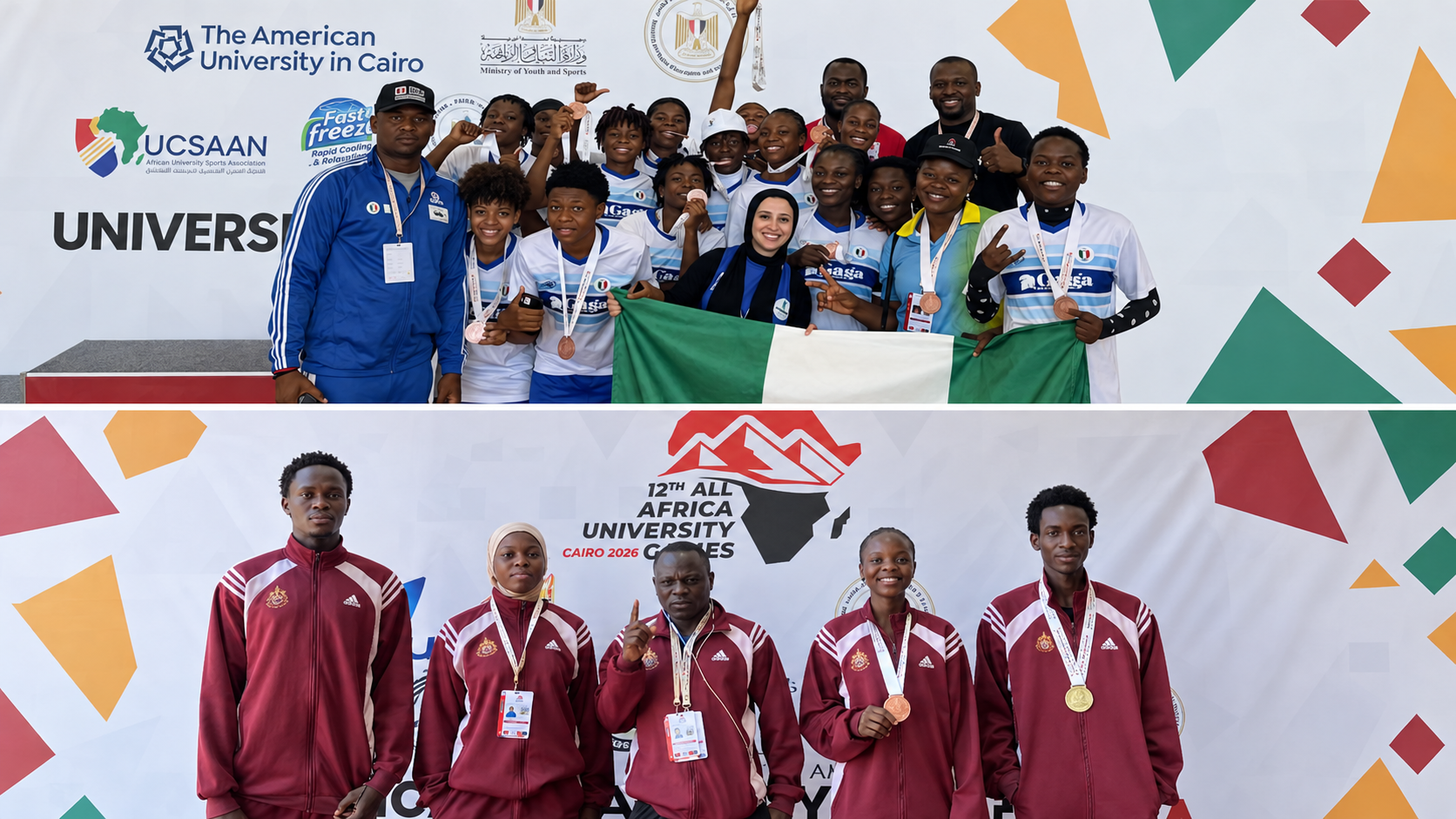
NIGERIA AT CAIRO 2026: GOLD, GRIT AND A GROWING UNIVERSITY SPORTS PRESENCE
Nigeria's participation at the 12th All Africa University Games in Cairo delivered medals, memorable performances and further evidence of the sporting talent emerging from the country's universities.
Held from 8 to 16 September 2026, Cairo 2026 brought together 2,082 participants-including 1,688 students and 394 administrators-from 82 universities and 18 African countries. The programme featured 18 main sports, four para-sports and three exhibition sports.
Nigeria was represented by institutions including the Lagos State University of Education (LASUED), Lagos State University (LASU), Nnamdi Azikiwe University (UNIZIK), Ladoke Akintola University of Technology (LAUTECH) and the University of Jos (UNIJOS). Their participation followed Nigeria's strong showing as host of the 2024 edition, when LASU and the University of Lagos finished second and third overall, respectively.
Although the Nigerian contingent in Cairo was smaller than some of the leading national delegations, its athletes still made an impact across taekwondo, judo, athletics and women's football.
LASUED STRIKES GOLD
Nigeria's standout triumph came through Florence Member of LASUED, who won the women's 67kg taekwondo title.
The victory was LASUED's first gold medal at the All Africa University Games and the first medal secured by a Nigerian university during the Cairo competition. Florence competed as part of a LASUED team that also participated in judo and badminton.
Her victory provided the defining moment of Nigeria's campaign. It also demonstrated the potential of athletes competing in disciplines that may not always receive the same attention as football or athletics within the country's university sports system.
Returning from Cairo as a continental champion, Florence gave LASUED a landmark achievement and Nigeria an important place on the top step of the podium.
FIVE MEDALS FOR LAUTECH
LAUTECH produced Nigeria's largest institutional medal haul, winning three silver and two bronze medals across taekwondo and judo.
Olanrewaju Abiola Praise was central to that success. She won silver in the women's under-49kg Kyorugi competition, contributed to the silver medal in the women's Team Poomsae event and added another silver medal in the under-60kg judo category.
Oladejo Sekinat Ajoke was also part of the silver-winning Team Poomsae squad and secured bronze in Pair Poomsae, while Oladimeji Abeeblahi claimed bronze in the under-55kg judo event.
LAUTECH's results underlined the value of developing student-athletes across several combat disciplines. They also showed how a relatively small delegation can make a substantial contribution when athletes are entered in events in which they have been properly prepared.
UNIZIK'S WOMEN DELIVER ON THE CONTINENTAL STAGE
Nnamdi Azikiwe University concluded its campaign with two silver medals and one bronze.
In athletics, Nnatu Benedicta Chinazaekpere won silver in the women's 3,000m steeplechase. Ogisi Mary added another silver medal in the women's Poomsae taekwondo event.
The UNIZIK women's football team then completed the university's medal collection with a commanding 3-0 victory over the German University in Cairo in the bronze-medal match. The result placed UNIZIK among the three leading women's university football teams on the continent.
The achievement carried additional significance because the team had also finished third at the 2025 NUGA Games in Jos. Repeating that result at continental level reflected the players' consistency and ability to compete beyond the national university system.
UNIZIK's individual medal winners followed a similar pathway. Both Nnatu and Ogisi had won silver medals in their respective events at the NUGA Games before reproducing those performances in Cairo. Their progression demonstrates how domestic university competitions can serve as an effective pathway to international competition.
A NINE-MEDAL RETURN
Published reports from LASUED, LAUTECH and UNIZIK account for nine Nigerian medals in Cairo: one gold, five silver and three bronze.
The medals were distributed across taekwondo, judo, athletics and women's football, with women responsible for the overwhelming majority of Nigeria's podium finishes. That pattern should provide an important point of reflection for university sports administrators and institutions seeking areas in which Nigeria can build sustained continental strength.
Nigeria's participation was not limited to competition. Nigerian students also contributed to the wider Games experience through volunteering, leadership and sports media. Student journalist Victor Oluwaseun Olabisi was among three Nigerians selected to participate in the continental gathering, adding a communications and youth-engagement dimension to the country's presence.
MORE THAN THE MEDALS
Cairo 2026 was designed as more than a sporting competition. Alongside the events, participants experienced cultural activities, academic discussions and opportunities to interact with students from across Africa.
The Games also made history by including para-sport for the first time, with competitions in para-athletics, para-badminton, para-swimming and para-table tennis. Participants also experienced Egyptian culture through visits to the Pyramids and programmes featuring cinema, music, arts and traditional crafts.
For Nigeria's student-athletes, Cairo offered exposure to different competitive standards, coaching approaches and university sports systems. It also allowed them to build friendships and professional connections beyond their institutions and national borders.
BUILDING TOWARDS THE FUTURE
Nigeria's campaign demonstrated both the promise within the country's universities and the need for broader institutional support.
The performances of Florence Member, Olanrewaju Abiola Praise, Nnatu Benedicta Chinazaekpere, Ogisi Mary and the UNIZIK women's football team show that Nigerian university athletes can compete successfully at continental level. However, increasing the number of participating universities, improving preparation and providing stronger financial and technical support would give more athletes the opportunity to reach the same stage.
University sport remains one of Nigeria's most important-but still underused-talent-development pathways. National competitions provide the first platform, while events such as the FASU Games allow the most promising athletes to test themselves internationally.
Nigeria may not have challenged for the overall university title in Cairo, but its representatives returned with medals, experience and a clearer picture of what is required to compete with Africa's strongest university sports programmes.
The challenge now is to build on that foundation: identify talent earlier, prepare athletes more consistently and strengthen cooperation among universities, NUGA, government sports institutions and the private sector.
Cairo 2026 showed that the talent is already present. The next step is creating the structure and sustained investment needed to help it flourish.
Comments (0)