

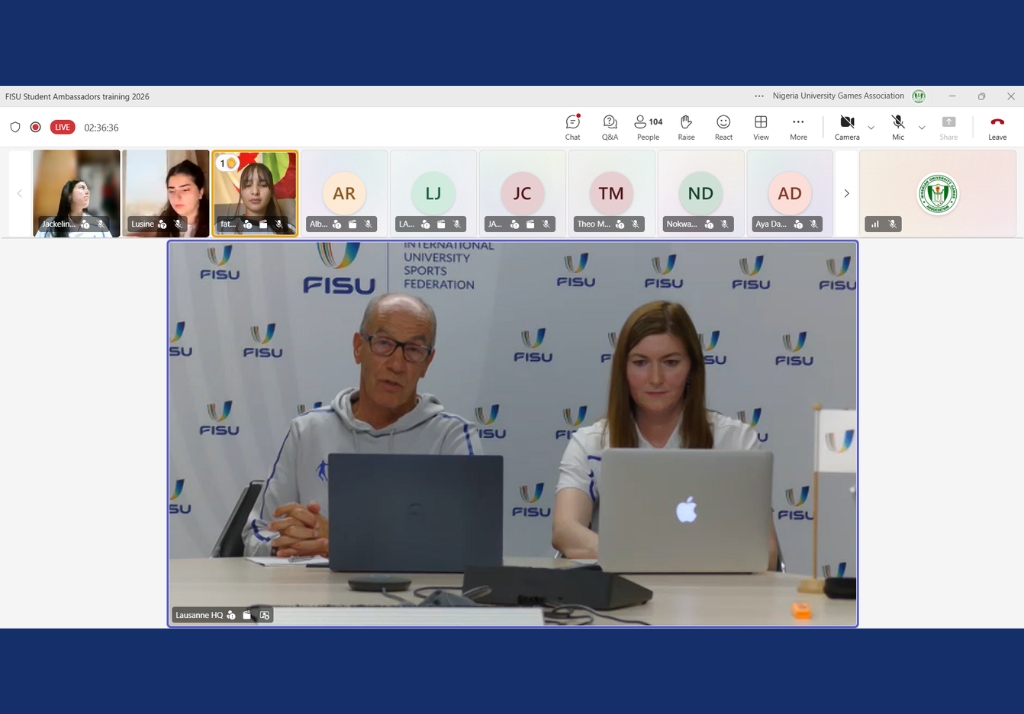
FISU Student Ambassadors Training 2026: Strengthening Student Engagement In University Sport
The FISU Student Ambassadors Training 2026 brought together student ambassadors for a two day programme focused on FISU's strategy, university sport, communications, branding, student wellbeing, development and the role of ambassadors within the university sports movement.
Held from 24 to 25 September 2026 at 15:00 CEST, the training also provided an opportunity for participants to better understand the wider FISU movement and how student ambassadors can contribute to university sport within their respective countries. NUGA participated as Nigeria's National University Sports Federation (NUSF), with its Media Liaison taking part in the programme.
Day 1 | FISU Strategy, Sport, Communications And Brand
The opening session featured FISU President Leonz Eder and FSA Programme Coordinator Albina Rakhmatullina, followed by contributions from FISU Secretary General and CEO Matthias Remund, FISU Summer Games Director Jing Zhao, FISU Communications Director Marianela O'Mahony and FISU Marketing and Branding Manager Adelia Faizulina.
Sessions focused on FISU Forward and Strategy 2031, FISU Sports Events, Communications and Media, and FISU Brand, followed by a cultural session led by team leaders.
A major focus was FISU's 2027 to 2031 strategic direction, built around four areas: Sport Events, Education, Student Wellbeing, and Resources and Sustainability. The strategy includes 16 core initiatives covering areas such as sport event development, education programmes, student participation, sustainability, technology and data, safeguarding and the FISU Master Programme.
The communications session examined how FISU develops narratives, manages media relations, supports event communications, monitors performance and works across its communication channels. The session also highlighted the wider communications team and the role of media in strengthening the visibility of university sport.
For NUGA, the sessions provided useful insight into how strategy, sport, communications and branding work together within an international university sports movement.
Day 2 | Education, Healthy Campus And Student Ambassadors
Day two featured Bertrand Fincoeur, Education and Development Senior Manager; Ivo Carvalhosa, Development and Healthy Campus Manager; Albina Rakhmatullina, FISU Student Ambassadors Programme Coordinator; Jackeline Torres Vargas, FISU Student Ambassador for Costa Rica and FSA Media Coordinator; Karolína Cepková, FISU Student Ambassador for Slovakia and Team Media; and FISU President Leonz Eder.
The sessions covered FISU programmes and events, the Healthy Campus Programme, FISU Student Ambassadors Programme, media and communications, and the role of students in strengthening university sport.
Particular attention was given to the FISU Student Ambassador journey. The 2026/27 roadmap includes September training and IDUS celebrations, meetings with NUSF and CUSF representatives, monthly educational sessions, individual action plans, participation in FISU and national or local events, and two midterm reports.
The programme is centred on action and participation, with ambassadors expected to develop individual action plans and work with their National or Continental University Sports Federation. FISU currently lists 728 Student Ambassadors from 143 countries, with participants aged 18 to 25 nominated by their federations.
Media and storytelling also formed an important part of the training. Ambassadors were encouraged to document university sport through photographs, videos, quotes and behind the scenes content while sharing and amplifying stories through official platforms.
The experiences of former ambassadors further demonstrated the different opportunities that can emerge from the programme, including roles as volunteers, attachés, organising committee members, media coordinators, team leaders and FISU committee members at major sporting events.
Healthy Campus And Student Wellbeing
The FISU Healthy Campus Programme was another key area of discussion, covering physical activity, mental and social health, nutrition, disease prevention, sustainability and social responsibility.
As of October 2025, the programme had reached 202 participating universities in 47 countries, with 108 universities certified.
The programme highlights the wider role of university sport in creating healthier and more supportive campus communities and reinforces the connection between sport, education and student wellbeing.
What This Means For NUGA
For NUGA as Nigeria's National University Sports Federation, the training provided an opportunity to better understand how student engagement can contribute to the development of university sport.
The sessions reinforced the importance of developing student ambassadors who can connect FISU with students, support initiatives, communicate university sport stories and contribute to activities at national and international levels.
The focus on communications and storytelling is particularly relevant to university sports development. Students and young people closest to sporting activities can play an important role in documenting competitions, sharing athlete experiences and making university sport more visible to wider audiences.
The training also strengthened the connection between student engagement, Healthy Campus initiatives, leadership development and the broader FISU movement.
Strengthening University Sport Through Collaboration
The FISU Student Ambassadors Training 2026 provided two days of learning, collaboration and practical insight into the future of university sport.
For NUGA, participation in the programme represents an opportunity to bring new knowledge into Nigeria's university sports ecosystem while strengthening connections with FISU, student ambassadors and other National and Continental University Sports Federations.
As university sport continues to evolve, programmes such as the FISU Student Ambassadors initiative provide students with opportunities not only to participate in sport, but also to contribute through leadership, communications, wellbeing initiatives and the development of the university sports movement.