

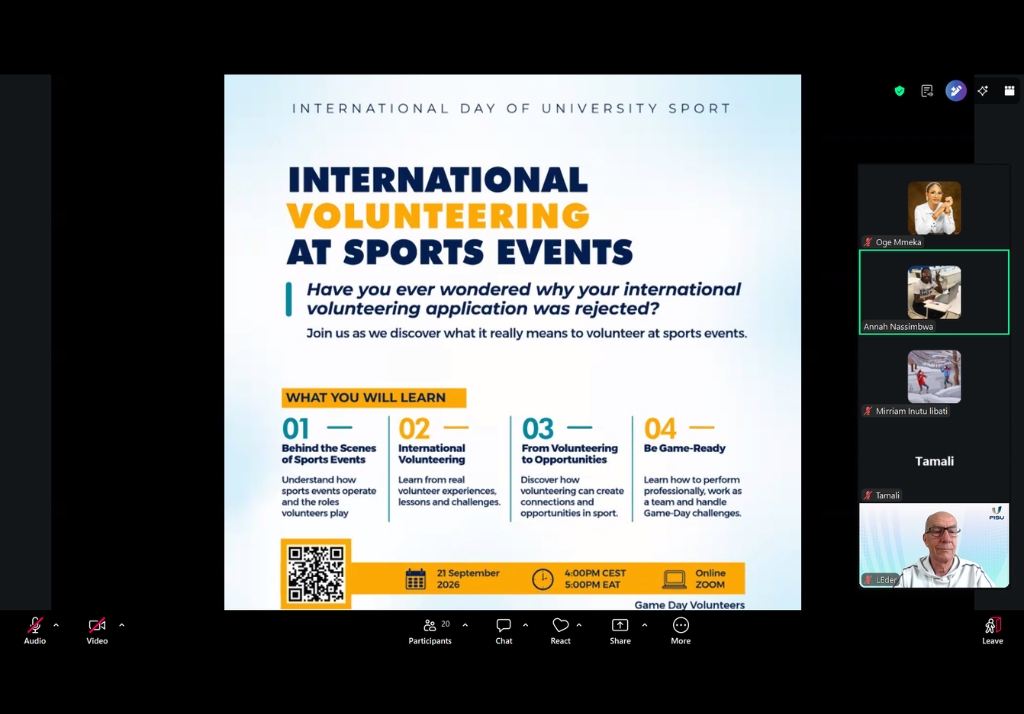
International Volunteering At Sports Events: From Volunteering To Opportunities
The International Day of University Sport (IDUS) 2026 session on International Volunteering at Sports Events brought together university sports stakeholders, student representatives and young people to examine the realities of volunteering at international sporting events and the opportunities that can emerge from the experience.
Held on 21 September 2026 as part of the IDUS 2026 programme, the session explored what happens behind the scenes of major sporting events, the different roles volunteers perform, how volunteer teams are organised and how volunteering can contribute to personal, professional and leadership development.
The session opened with remarks from Dr. Leonz Eder, President of the International University Sports Federation (FISU), who served as the keynote speaker. His opening contribution set the context for the discussion on international volunteering and the role of university sport in creating opportunities for young people.
Mrs. Penninah Kabenge Aligawesa, Vice President of FISU, also contributed to the session, bringing attention to the wider importance of sport and the opportunities that university sport can create for young people. Her contribution reflected her strong commitment to the development of sport and the role of university communities in advancing participation, leadership and connection through sport.
The session then examined the four stages of event management, covering conception, preparation, exploitation and closure. Participants were taken through the process of developing an event from the initial idea and objectives, through planning and resource allocation, to execution, coordination, attendee management and eventual evaluation.
The discussion also highlighted the range of areas in which volunteers can work. These include security and stewarding, finance, technical operations, secretariat, transportation, general services, team attachments and welfare. Volunteer selection may be based on qualifications, interests and the requirements of particular teams, showing that volunteering involves different levels of responsibility and areas of expertise.
A major part of the discussion focused on why people volunteer. Beyond the opportunity to attend or experience a sporting event, volunteering can provide travel and fan experiences, access to events, learning and apprenticeship opportunities, practical experience, networking, professional profile development and the opportunity to serve.
Aupal Emmanuel, FASU Student Representative, shared from his personal experience as an international volunteer, describing volunteering as a journey built around experience, people, skills and opportunities. He encouraged volunteers to look beyond certificates and consider the knowledge, relationships, skills and possibilities that can develop through their involvement.
The session also examined the importance of coordination and people management in sporting events. Hannington Musoke, Principal Sports Officer at Buganda Kingdom, spoke about the different reporting structures that may exist during an event and the importance of understanding the people within a team. His contribution emphasised that effective coordination goes beyond following lines of command, requiring sensitivity, communication and an understanding of how different individuals respond to pressure and responsibility.
The discussion then moved from individual volunteering experiences to the broader development of university sport in Africa. Presentation data on the growth of IDUS activities showed that the 2020 IDUS celebrations in Africa reached 27 countries, recorded 45,950 participant engagements, generated 245,556 campaign impressions, while 21 countries participated in the Africa Social Media Challenge.
These figures provided a picture of how IDUS has developed as a platform for connecting university communities across the continent. The presentation highlighted the role of the initiative in celebrating university sport, mobilising universities, engaging students, promoting health, advancing inclusion, developing leaders, connecting Africa and inspiring action.
The session also reflected on the potential of university sport as a practical learning environment for Africa's young population. Beyond competition, university sport can provide opportunities for students to develop leadership, employment, entrepreneurship, communication and administrative skills. Volunteers can therefore develop pathways into areas such as coaching, sports administration, event management, officiating, education, entrepreneurship, communications and sports leadership.
The presentation further highlighted FASU's use of sport to strengthen connections across Africa, with IDUS activities supporting broader engagement beyond the playing field. This was reflected in the various initiatives presented, including social media challenges, university sports webinars, community activities and programmes connecting students and stakeholders across different countries.
Ms. Anne Mwebe, who served as host and moderator, guided the conversation and connected the different perspectives throughout the session. Her moderation helped move the discussion from the operational side of volunteering to the personal experiences, lessons and opportunities associated with participating in international sporting events.
Also contributing to the session was Alicia Lara Gracia, FISU Student Ambassador from Spain, who brought the perspective of student representation within the international university sports environment.
The session demonstrated that volunteering at sporting events involves more than providing support on game day. It exposes students and young people to event systems, teamwork, coordination, communication and professional networks while creating opportunities to develop skills that can remain valuable beyond the event itself.
As IDUS marks its 10th anniversary, the discussion placed renewed attention on the role of university sport in creating platforms where students can participate, connect, learn and develop. The experience of international volunteering further shows how participation in university sport can become a pathway from students helping events to students building capabilities through sport.